How Body Fat Calculator Works
The Body Mass Index (BMI) Calculator can be used to calculate BMI
value and corresponding weight status while taking age into consideration. Use the
"Metric Units" tab for the International System of Units or the "Other Units" tab to
convert units into either US or metric units. Note that the calculator also computes
the Ponderal Index in addition to BMI, both of which are discussed below in detail.
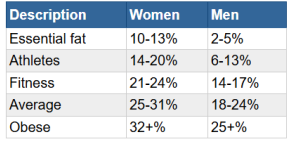
The American Council on Exercise Body Fat Categorization
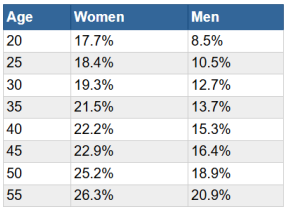
Jackson & Pollock Ideal Body Fat Percentages
Body Fat, Overweight, and Obesity
The scientific term for body fat is "adipose tissue." Adipose
tissue serves a number of important functions. Its primary purpose is to store
lipids from which the body creates energy. In addition, it secretes a number of
important hormones, and provides the body with some cushioning as well as
insulation.
Body fat includes essential body fat and storage body fat. Essential body fat is a
base level of fat that is found in most parts of the body. It is necessary fat that
maintains life and reproductive functions. The amount of essential fat differs
between men and women, and is typically around 2-5% in men, and 10-13% in women. The
healthy range of body fat for men is typically defined as 8-19%, while the healthy
range for women is 21-33%. While having excess body fat can have many detrimental
effects on a person's health, insufficient body fat can have negative health effects
of its own, and maintaining a body fat percentage below, or even at the essential
body fat percentage range is a topic that should be discussed with a medical
professional.
Storage fat is fat that accumulates in adipose tissue, be it subcutaneous fat (deep
under the dermis and wrapped around vital organs) or visceral fat (fat located
inside the abdominal cavity, between organs), and references to body fat typically
refer to this type of fat. While some storage fat is ideal, excess amounts of
storage fat can have serious negative health implications.
Excess body fat leads to the condition of being overweight and eventually to
obesity given that insufficient measures are taken to curb increasing body fat. Note
that being overweight does not necessarily indicate an excess of body fat. A
person's body weight is comprised of multiple factors including (but not limited to)
body fat, muscle, bone density, and water content. Thus, highly muscular people are
often classified as overweight.
The rate at which body fat accumulates is different from person to person and is
dependent on many factors including genetic factors as well as behavioral factors
such as lack of exercise and excessive food intake. Due to varying factors, it can
be more difficult for certain people to reduce body fat stored in the abdominal
region. However, managing diet and exercise has been shown to reduce stored fat.
Note that both women and men store body fat differently and that this can change
over time. After the age of 40 (or after menopause in some cases for women), reduced
sexual hormones can lead to excess body fat around the stomach in men, or around the
buttocks and thighs of women.